Thursday, August 5, 2010

Precipitation Harvesting in Antiquity

The Cistern

Since the dawn of early cultures people have not only used natural water resources but also improved them by artificial methods. Based on observations of nature they constructed small and large storage vessels for temporary storage and transfer of water.
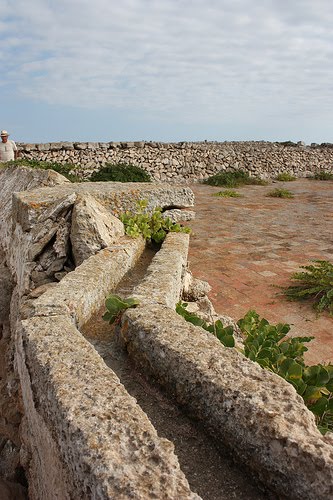
Cisterns were originally constructed in the region around the Mediterranean since the 3rd millennium B.C. Typically early cisterns were shaped into the natural rock with an inlet being covered by stones or wooden plates. In Roman times the use of stone as structural building material was introduced to cistern design. To avoid seepage and water loss the joints were filled with plaster. Population numbers of entire regions were dictated by the local cistern storage capacity. Modern cisterns range in capacity from a few litres to thousands of cubic metres, effectively forming covered reservoirs.

Umayyad Cistern, Jordan.


Vaulted Roman cisterns

Cistern chambers on the La Fourvière hill in Lyon (France)

Cistern Prachinburi Province, Thailand

Cistern, Iran.

Sketch of Nabataean cistern in Auara, Jordan. Built for private use by individual families. Storage capacity 200 m3.

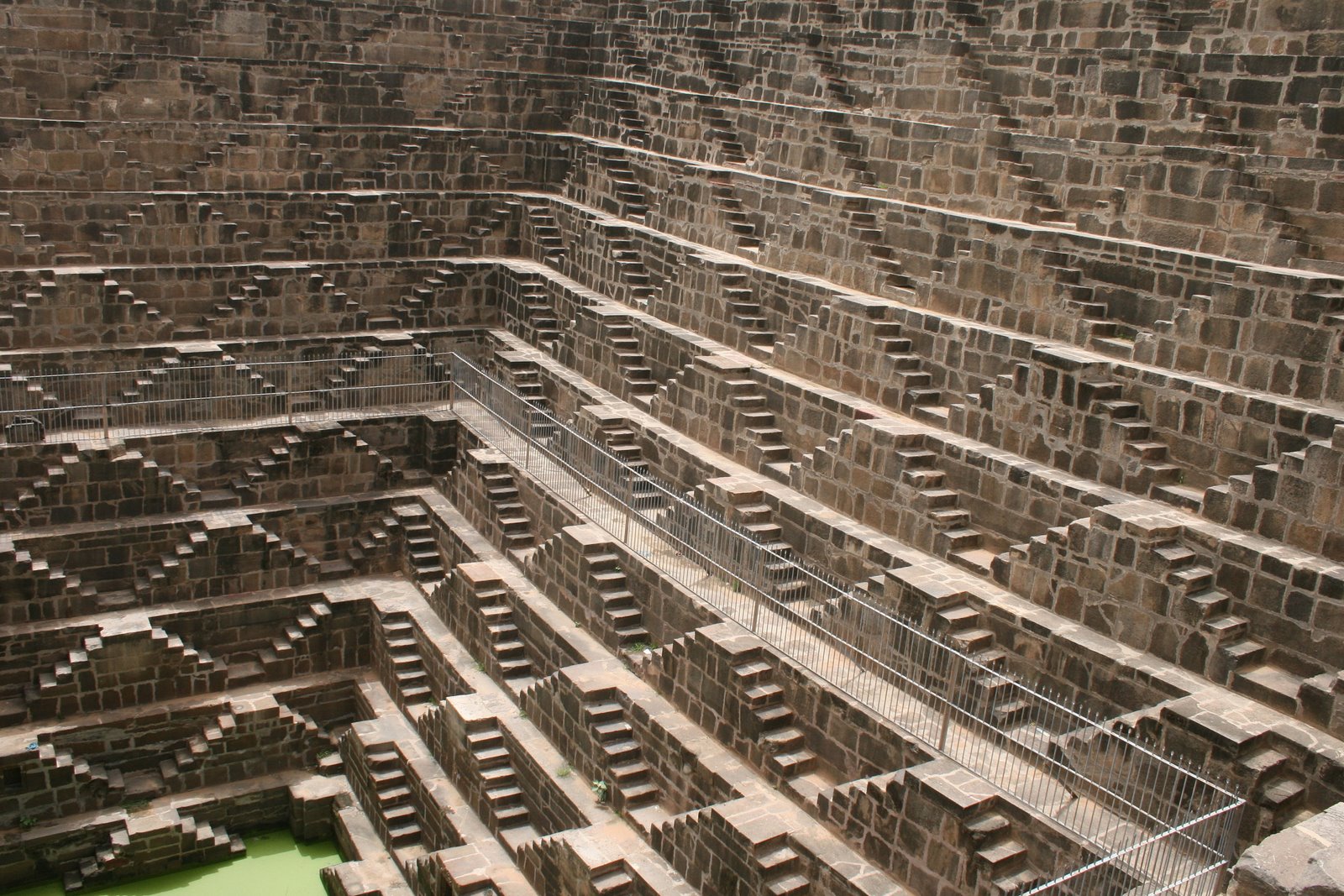
Chandra Baori step well
This step well is located opposite Harshat Mata Temple and is one of the deepest and largest step wells in India. It was built in the 9th century and has 3500 narrow steps in 13 stories and is 100 feet deep.


Roman cisterns, aqueducts and step wells.


The Basilica Cistern or "Sunken Palace" lies beneath the city of Istanbul.

Friday, July 30, 2010

Photographic Evidence

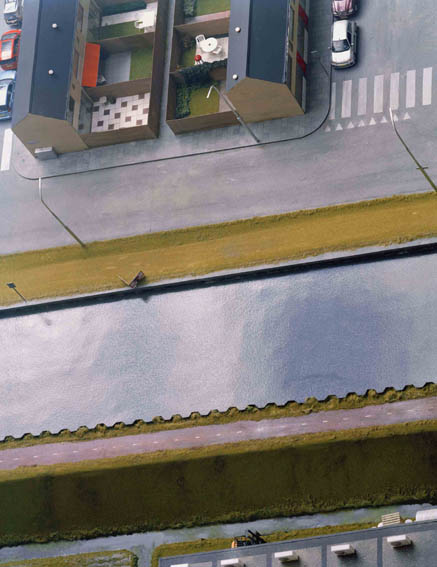
Edwin Zwakman puts a new spin on the long standing tradition of recording the Dutch landscape. The images below are from his 2004 series titled "Backyards".

Fly-Over III, C-print plexi, reynobond, 220 x 161 cm 2003


Straat II, C-print, plexi, reynobond, 220 x 157 cm 2004


Tuin IX, C-print, plexi, reynobond, 220 x 146 cm 2004


Tuin I, C-print, plexi, reynobond, 220 x 146 cm 2004


Tuin III, C-print, plexi, reynobond, 220 x 146 cm 2004


Tuin V, C-print, plexi, reynobond, 220 x 146 cm 2004


Tuin V, C-print, plexi, reynobond, 220 x 146 cm 2004


Tuin V, C-print, plexi, reynobond, 220 x 146 cm 2004


Tuin VI, C-print, plexi, reynobond, 220 x 146 cm 2004


Tuin VIII, C-print, plexi, reynobond, 220 x 146 cm 2004


Tuin VIII, C-print, plexi, reynobond, 220 x 146 cm 2004


Monday, July 26, 2010

Green Streets Victoria BC

I am currently working on a project with a scope of work that extends beyond the boundaries of the site. The idea is to work with the city of Victoria to include a Green Streets concept to the development's adjoining streets.
What is a Green Street? Well it includes but is not limited to a sustainable stormwater strategy that meets regulatory compliance and resource protection goals by using a natural systems approach to manage stormwater, reduce flows, improve water quality and enhance watershed health.

The project brief looks something like this:
- Traffic calming
- Improving pedestrian and bicycle safety
- Reducing the demand on the city’s sewer collection system and the cost of constructing expensive infrastructure / pipe systems
- Diverting stormwater from the sewer system
- Reduction of impervious surfaces so stormwater can infiltrate to recharge groundwater and surface water
- Increasing urban greenspace
- Enhancing community and neighborhood livability.

Can't tell you much more about the project at this point but I have included similar projects in the Portland and greater Victoria area to get you thinking.


A new way of managing stormwater run off.
NE Siskiyou Green Street, Portland, Oregon. Photo by Kevin Robert Perry.


Checkdams made from packed earth and river rock are used in each curb extension to slow and retain stormwater runoff.
NE Siskiyou Green Street, Portland, Oregon. Photo by Kevin Robert Perry. NE Siskiyou Green Street, Portland, Oregon. Photo by Kevin Robert Perry.


NE Siskiyou Green Street, Portland, Oregon. Photo by Kevin Robert Perry.


NE Siskiyou Green Street, Portland, Oregon. Photo by Kevin Robert Perry.


Trent Street Rain Garden Victoria BC.
A great local project by the forward thinking minds over at Murdoch de Greefe Inc.


(SW 12th Avenue Green Street Project, Portland, Oregon. Photos by Kevin Robert Perry.)


(SW 12th Avenue Green Street Project, Portland, Oregon. Photos by Kevin Robert Perry.)


(SW 12th Avenue Green Street Project, Portland, Oregon. Photos by Kevin Robert Perry.)


(SW 12th Avenue Green Street Project, Portland, Oregon. Photos by Kevin Robert Perry.)

For all things Portland, Landscape and Urbanism based, check out Jason Kings Blog here.

Monday, July 19, 2010

sketch

Lately my studio work has been filled with detailed renderings and construction drawings.
I find a great way to loosen up from hours in front of the computer is to produce a series of quick sketches. Unhindered by the rigidity of CAD, the idea is to let the eye and hand work together seamlessly. The image below was produced in 10 minutes.

Thursday, July 8, 2010

Olive tree and Spaniel

Old friend and London based garden designer Jonathan Snow sent me this image he captured while on a plant buying trip for a client.
When you visit a nursery it usually never hurts to take an image of specimen trees they have in stock that you may want to use on future projects.
When appropriate, these select images are great for giving your clients a visual idea of what you are intending to plant.
"Notice the architectural branching structure of this mature Olea europaea".

Thursday, June 24, 2010

design development

Although this is still work in progress I thought I would post some design development work completed for one of my new projects. The visuals below are snapshots of my massing model. The green indicates planting strategy zones including a series of tiered green roof planting areas. More to come, click images for a closer look....

overview west


overview east


close up of tiered roofing system

Tuesday, June 22, 2010

1:1

I just finished reading Michael Pollan's A Place of My Own: The Architecture of Daydreams.
The book recounts Pollan's process of designing and constructing a small one room structure on his rural Connecticut property. But please do not get the wrong impression here. This book is by no means a step by step or one of those painful DIY manuals. Pollan's almost poetic writing explores the complex relationship between the language of landscape, architecture and the human spirit.

Although his approach to site selection, design and construction can be applied to any scale of project his book left me with a deeper appreciation for compact spacial design. Enter in.......

1:1 Architects Build Small Spaces at the V & A
Using the landscape of the Museum as a test site, the V&A invited nineteen architects to submit proposals for structures that examine notions of refuge and retreat. From these nineteen concept submissions, seven were selected for construction at full-scale.

Small spaces such as these can push the boundaries and possibilities of creative practice. A shift in scale towards smaller, bespoke structures encourages a heightened sensitivity to materials, texture and proportion. A renewed clarity emerges, allowing architects a freedom of expression that often struggles to survive in larger building projects.

Terunobu Fujimori
Tokyo, Japan
Beetle’s House

Much of Terunobu Fujimori’s architecture aims to reconfigure our view of the natural landscape around us. Reaching this ‘floating’ teahouse via a ladder, visitors are rewarded with an elevated view of the surrounding galleries. The charred, blackened timber exterior, with its textured and tactile surface, represents an extreme of materiality. The process of burning the wood also acts to preserve the building material, thus increasing the structure’s lifespan.


Rural Studio
Newbern, Alabama, USA
Woodshed

Rural Studio is an architectural education programme dedicated to building affordable housing for poor rural communities in Western Alabama. This noble, utilitarian and extendible shed is constructed entirely from forest thinnings. ‘Thinning’ is a forest management practice where small, constricted trees are removed from among larger, more ‘viable’ trees. At a market cost of roughly £2 per metric tonne, thinnings provide a plentiful, renewable, affordable – and underutilised – source of construction material.


Helen & Hard Architects
Stavanger, Norway
Ratatosk

This climbing structure excavates our half-forgotten memories of childhood play and exploration. Ten ash trees will be cut along the length of their trunks and planted face to face. The resulting two rows will allow visitors to enter the ‘interior space’ of the trees. The branches will be handwoven and then grafted onto the tree stumps to form a delicate canopy that hangs over a soft play-surface.


Rintala Eggertsson Architects
Oslo and Bodø, Norway
Ark

Situated by the V&A’s National Art Library, this freestanding wooden tower re-evaluates the concept of the ‘archive’. Its walls are made up of hundreds of shelves, holding thousands of second-hand books. Accessed via a spiral staircase, each floor includes a secluded reading chamber. Positioned to face inwards, the book spines form an exterior façade of monotonous white, whereas the interior view consists of a rich collage of colours and typographic textures.


Sou Fujimoto Architects
Tokyo, Japan
Inside / Outside Tree

This structure creates a space where notions of ‘inside and outside’ and ‘nature and artificiality’ are inverted and convergent; it explores the crucial duality and ‘in-between-ness’ that defines traditional Japanese architecture. The interior surface of the hollow, transparent tree is continuous with the exterior of the cube form that surrounds it. Thus, one can stand outside the cube and inhabit the same space as the tree’s interior, and vice versa.


This project did not get to actualizing stage but would I have loved to see it built.
Sou Fujimoto Architects
Tokyo, Japan
Silent Gardens

Eleven acrylic boxes contain a series of meticulously reproduced plant and flower forms. Despite their formal geometry, the boxes are liberated from any sense of order and stacked with a spirit of spontaneous logic. The imperceptible thresholds between the boxes would allow the structure to resemble an organically grown elevated garden, resulting in a delicate balance between reality and fiction.

for more info check it out 1:1 V&A

Monday, June 14, 2010

beyond the hive

I guess I wasn't the only one thinking about planning for biodiversity.
Thanks to my UK subscribers for sending in the link below.

"The Beyond the Hive competition, run by British Land and the City of London Corporation, sought proposals for an ecologically sustainable and creative insect habitat. The hotels were designed to attract stag beetles, solitary bees, butterflies, spiders, lacewings and ladybirds and will be built at Bunhill Fields, West Smithfield, Postman’s Park, St Dunstan’s in the East and Cleary Garden, all in the City". via www.britishland.com

the insect hotel by arup associates

"The shortlisted projects are: the Inset Hotel by Arup Associates; Brookfield Bug Buddies by Brookfield Europe and the Pinnacle team; Bumblebee City Nesters by Fisher Tomlin; Inn Vertebrate by Metalanguage Design; and Beevarian Anstel and Gretel Chalet by German Women in Property. Two “golden beetle” awards will be presented – one to the winner of the public vote and one to the judges’ favourite – during the London Festival of Architecture. Sue Ireland, the corporation’s director of open spaces, said: “We are absolutely delighted with the high standard of design and presentation that went into all the entries. “Ultimately this will enhance the City’s biodiversity, through the provision of well-crafted, sustainable and beautiful insect hotels.” via www.britishland.com


bumblebee city nesters by fisher tomlin


beevarian anstel and gretel chalet by german women in property


brookfield bug buddies by brookefield europe and the pinnacle team


vertebrate by metalanguage design

to vote for your favorite project visit www.britishland.com